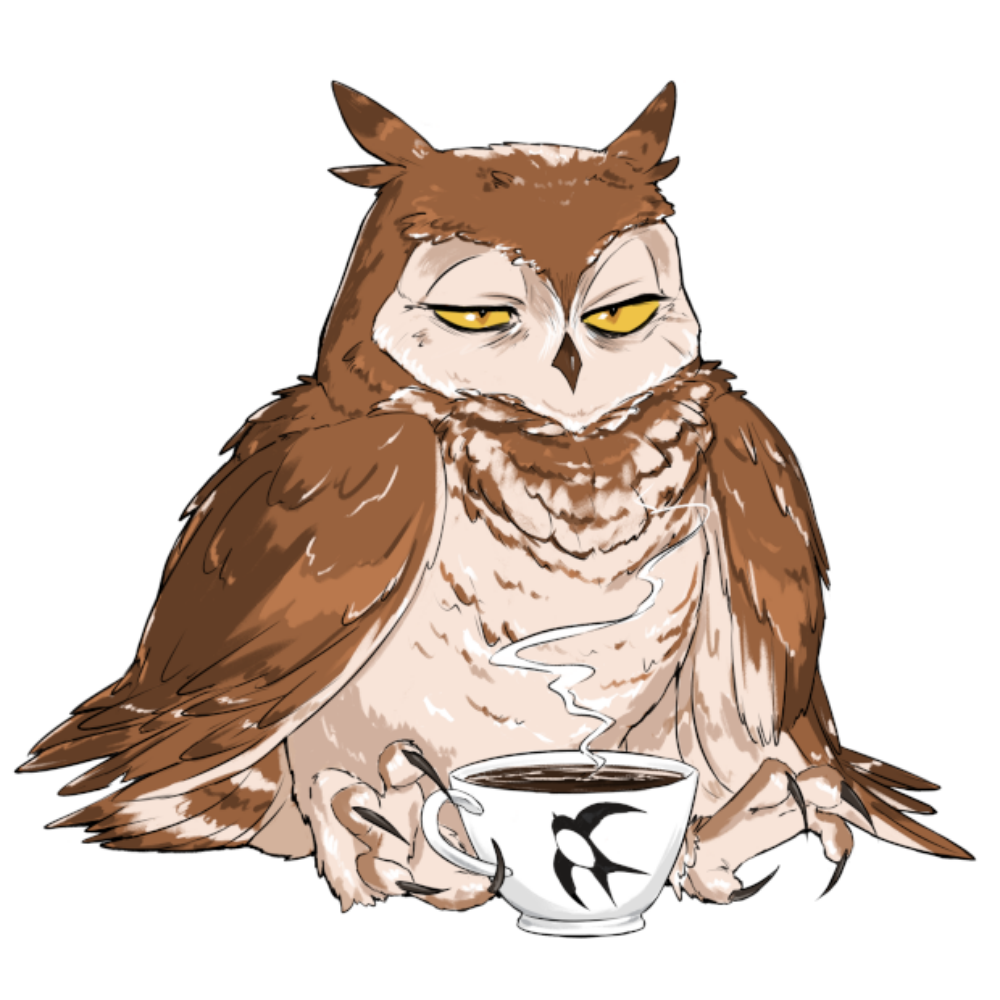
Now, be so good and fill my cup, fill it to the brim, be so kind, so I may partake of that sweet lubricant for my poor, strained throat, and then pull up that chair of yours closer to the fire and listen well, for ’tis time I told you the story I promised to tell long ago. No, I didn’t forget, I didn’t forget at all. I said ’twas a tale for another time back then, and that time is now, and that tale is the tale of when Het met Prim again on the road, and this is how it goes.
Pree Prim walked the road. She walked the road to master it. That is well-known. As well-known as the fact that she would eventually master it, indeed. But, back then, she hadn’t mastered it quite yet, and so she walked on endlessly. Which is not to say that she would halt once she would master it, quite to the contrary, but nevertheless, there she was, walking the road ad nauseam and beyond, the poor blessed thing. She had walked ragged and tattered so many shoes and boots and sandals and wrappings that she had lost count. Yet, to her, that mattered not. She had the road ahead of her and the road in her back and the road under the soles of her feet. And so she strut on, bare-footed and ever-marching, bent towards the horizon and accustomed to the dirt and dust between her toes and the callouses and cuts on her skin and the blisters and bruises on her legs and all the other gifts which the branches and stones and rocks under her feet kept giving her.
Thusly making her way, she once found herself in strange, grisly lands, where a heavy quiet suffocated the very air. Beside her, the blades of grass swayed silently in the noiseless winds. The dark-barked trees’ leafless branches pierced the red horizon like thorns. Not a single black bird dared utter even a single caw, let alone song. But the road led her through there, and so Prim followed it, as she always did, shivering for the haunted lands she was crossing.
Once the skies darkened as well, the weary Prim sought rest and shelter for the night. She curled up underneath a wide tree, whose thick roots protruded above ground and curved in gentle serpentine lines, making for a comfortable lean to curl into. But once the black of night descended upon those lands, distant horrors awoke and their terrifying screams, carried by the silent winds, bellowed dreadfully and endlessly. Prim clenched her greatknife tightly and, trembling in fear, didn’t close a single eye that night, the poor thing.
As the dawn cut through the night’s veil, so did the screams subside. Prim rose and returned briskly to the road, desiring to leave these accursed lands as swiftly as her feet would carry her. And thusly she hurried along, but she hadn’t gotten far at all before she came across the pungent stench of death as the winds bore the fruits into her nostrils which the violence that had unfolded the previous night had blossomed.
It was then that Prim spied a womanly figure in the middle of the road ahead of her. The woman sat there in the dirt, hugging her knees and shivering. She was bathed in blood and dirt, and a thick, long staff lay beside her, while a dozen corpses of foul beasts, sharp-toothed and long-clawed demons clad in fur of the deepest emerald green, surrounded her trembling self. Her head snapped as she noticed Prim approaching, who behind her back in her hand held firmly her greatknife’s handle.
“Who goes there?” the woman called.
“They call me Prim,” said Prim, “and who may you be?”
“Prim?” said the woman, “Prim, daughter of Hansa?”
“The very same,” said Prim.
“In other circumstances, I would greet you heartily and bid you welcome,” said the woman, “but in this place and on this day, it would do better to wish you far away from these forsaken lands.”
“You speak as if you know me,” said Prim, “yet, I must admit, I do not recognise you.”
The woman leapt to her feet. “Forgive me, Pree Prim,” she said, swiping blood and dirt off her face, “the execution of my grisly work must be masking me thoroughly. I am Het, the Guardian at the Doors.”
“Pree Het,” said Prim and bowed deeply, as was custom, “accept my apologies.”
“Think nothing of it, Pree Prim,” said Het. “What brings you here, of all places?”
“I walk the road,” said Prim.
“Here?” said Het.
“Wherever it takes me,” said Prim.
“You’d do well to leave quickly, then,” said Het, “for these lands are plagued thoroughly by evil.”
“I had no intention of whiling,” said Prim.
“Good,” said Het. “Now come, I shall accompany you for a stretch. I need to head down the road for a bit as well, for the camp I set up is that-a-ways too.” And she beckoned Prim to follow her, and Prim did so eagerly, all too happy for her feet to carry her as far down the road and away from this place as they could.
“What brings you here?” said Prim as she trotted alongside Het, “It was my understanding your duties were at the gates of YISUN’s speaking house.”
“They are,” said Het, “but it is my duty also to vanquish evil, for I am a Watchman too. And here it has festered in darkness and grown so formidable in the shadows that its stench was smelled a world over. Hence, I was sent to purge it.”
“On your own?” said Prim.
“On my own,” Het nodded.
“That doesn’t seem right,” said Prim. “Clearly, the evil here is strong. It permeates everything. The very air curls my skin. I should’ve thought they’d sent an entire army.”
“No, just me,” said Het and picked up her pace.
“But you’re covered in wounds,” said Prim worriedly.
“They’ll heal soon enough, as they always do,” said Het. “Worry not. I have departed many an evil from life in my time. You shall be perfectly safe while I’m here. Besides, the beasts despise the sun’s brightness; they’ll remain covert while the lights of day last.”
And so they marched for a while until Het stepped off the road and made for the woods. “A calm river flows nearby,” she said, “where we may rest, for ’tis as good a resting place as any, and I may bathe and rid myself of the blood and guts on me.”
Prim nodded and followed her, and they soon reached a wide yet shallow and slow-moving river, where they drank their fill and bathed together, and Het cleaned the blood and dirt off herself and washed her wounds. And Prim, the Gentle One, tore the rim of her vela and tied Het’s gushing wounds so they may heal well and quickly, and Het thanked her, as was custom.
“I still do not understand,” said Prim, “why they would send the Goddess of Thresholds on her own to vanquish the evil of these lands.”
“Evil is a fine line,” said Het. “It is so in several ways. Tell me: Do you call a lion evil for feeding on the deer’s flesh?”
“No,” said Prim. “It is its way.”
“Indeed,” said Het, “it is its way. And do you call a devil evil for feasting on suffering and torture?”
“Is it necessitated by its survival?” said Prim.
“Does that matter?” said Het.
“I believe so,” said Prim.
“Be it so or otherwise,” said Het, “it is its way.”
Prim considered this. “There must be a difference,” she finally said. “The same difference between desire and need, pleasure and necessity.”
“Maybe,” said Het, “yet that difference shall look quite differently whether you ask the lion or the deer.”
As Prim pondered this response, Het went on. “And then, there is the question of quantity,” she said. “Purge evil entirely, and it will grow plentiful by itself in due time, for where there is an opportunity, a claw or fang shall eventually extend to grasp it, same as an electron shall eventually occupy a lower quantum state given its availability and ample time. Such is the law of probability and such is the law of everything which knows hungers, for where there is hunger, there is temptation. Kept bounded to a certain limit, though, and it will be recognised for what it is and hunted down. Let it fester unopposed for but a breath too long, however, and it shall flourish too mightily to be contained, and it shall feast gluttonously on blood and pain and suffering. There is no such thing as purification nor purity, just a fine line between the law of hungers, the dreadful algebra of necessity, the law of large numbers, and an opportunity taken. And so it shall be as long as the Wheel turns.”
“That doesn’t seem right,” said Prim. “Purity is no more than fantasy and illusion, I know that well; yet there must be something just and noble opposing the horrors and malice, too, must there not? Can there be no such thing as justice?”
“I do not understand justice,” said Het. “I have imprisoned men in one city for drinking on a holy day, and I have imprisoned men a city over for not drinking on a holy day, as customs dictated. I have executed men for stealing and I have attended kings’ parades celebrating their conquests and pillages. As far as I have seen, one man’s justice is another man’s cause for war. There is no clear cut threshold, no marks hewn in stone so they may outlast eternity; there is but a line that vanishes into thin air with the word that spoke it, a line drawn in chalk that washes away with the next rain. So I do not understand justice, and so justice is not my business. I enforce the old laws and vanquish evil where it thrives. That is my work, and that is why I am here, and that is why they sent me. If they wanted justice, they should’ve sent a justice god.”
Before Prim could reply, the cracking of branches, rustling of leaves, and the noise of footsteps in the woods interrupted her, whereupon three figures appeared from the thickets. The three men clad in rags torn to shreds limped and wheezed towards the river until they noticed the goddesses, which made them freeze in their tracks.
“Ho there!” Het shouted with fearsome clarity, reaching for her heavy staff, “Be you men or beasts?”
“Who calls there?” the bearded one of the three yelled back with a trembling voice.
“I am Het, the Guardian at the Gates and YISUN’s Watchman!” shouted Het and struck the ground firmly with her staff, and the earth shook under her might.
“Praised be YISUN for sending us your way,” the men said, “we’ve been fleeing through these cursed woods filled with cursed demons and their cursed teeth and claws. We’ve lost a dozen companions just last night, and so we ran, but we have lost sight of the road.”
“Be at ease,” said Het, who did not detect a lie in their words for there was none to detect, “I shall escort you back onto the road and the path out of these lands, as my encampment lies that-a-ways too, and no harm shall befall you while I’m with you.”
And the three men thanked her profusely and bowed deeply, as was custom, and Het led them all back onto the road. They advanced slowly, as the men’s numerous wounds hindered their speed, and Prim and Het lent them their shoulders to share some of their burdens as they limped and wheezed each step of the way. Hence, it took them hours to reach the ruins of a former fortress, built in ages untold to guard the road and its travellers, and they arrived when the sun had already begun to set.
“It is here,” said Het, “my encampment lies within the keep. I have mended the doors and filled the holes in the walls with stone and timber.”
It was indeed as Het had told it to be: The keep’s walls, albeit old, were yet sturdy for the most part, and where they had crumbled, Het had filled the holes with thick timber and stones, of which plenty lay about in the ruins.
“The hour has grown later than I hoped,” said Het, eyeing the sinking sun. “The wounded have slowed us down greatly indeed. No matter, what is done is done. You lot should while in the keep and wait out the night, when the devils shall surely emerge again. You’ll be safe in there until the morning lights embrace these lands once more.”
And Prim and the three men agreed to stay all too gladly, for none was too eager to spend the night outside the thick stone walls. So they hastily gathered some wood and lit a fire in their midst to keep them warm and dry during the night.
As the daylight reddened further, the company grew quieter and huddled by the fire in silent contemplation, whilst isolated screams of rabid beasts spawned in the far distance, saturating the air with so much dread that Prim could see it dripping.
“They’re quieter than they were yesterday,” muttered Het, and the three men nodded in agreement, as if to convince each other that was indeed the truth.
And soon enough, mere moments after the sunlight’s last rays had disappeared beneath the horizon, they heard the deep grunts, the ragged breaths, and the chilling scraping of razor-sharp claws against stone and rock just outside the walls which kept them safe.
“They found us rather quickly,” said the bald man.
Het rose to her feet. “It is time,” she said. “I shall head outside now and fight the demons once more. You lot stay here and bolt the door behind me. Do not open it until I return or until the morning sun shines above your heads. I shall knock seven times and call out, and that is how you will know it is I. No evil shall pass this door, or I am not Het, God of Thresholds and YISUN’s Watchman.” Her voice was firm and her hand steady as she grasped her heavy staff, yet she couldn’t conceal the tremble in her knees fully.
As Het stepped outside, Prim bolted the door behind her, just as Het had requested, and joined the men back by the fire in silence. They listened attentively to the rabid screeches and screams on the other side of the door, which were ever so often interrupted by pain-filled whimpers and harrowing loud cracks of skulls and bones breaking under the swings of Het’s heavy staff.
“Pray tell,” the bearded man said suddenly, “Do you think she may kill them all?
“Perhaps,” said the tall man serenely.
“Are you not afraid?” said Prim, astonished by the tall man’s calm.
“I trust in the strength of my companions,” said the tall man.
“Have you met Het before?” said Prim.
“I have not,” said the tall man, “but I have heard of her.”
“So have I,” said Prim. “I have heard much of Het’s strength and deeds. Yet I cannot help but shudder in fear from the sounds of ruthless battle and broken bodies outside that door.”
“There is no use drowning in fear,” said the bald man. “Things shall pass as they must.”
Prim contemplated this and finally said, “Is that why you travelled these cursed lands whilst bearing no arms?”
“There is no use in carrying arms,” said the bald man, “Even if we had any, we wouldn’t know what to do with them. We are travellers, not mercenaries.”
“I had thought you may have lost them in battle or tossed them in your flight,” said Prim. “To cross these demon-riddled lands with no arms, some would call this folly.”
“There is no use drowning in fear,” said the bearded man. “Things shall pass as they must.”
Prim gave it a thought. “Perhaps it is indeed not folly,” she finally said. “As leaves belong in a tree’s crown and ants belong in an anthill, so do demons belong in evil lands they own.”
The three men stared intently at Prim as the fire between them crackled.
“You are demons too, are you not,” said Prim.
The three men looked at each other in bewilderment and then eased into wide grins.
“Well-seen,” said the tall man. “We would have waited for a bit longer, but alas, we shall begin now, then.”
The men’s shapes slowly turned into their devilish forms as their limbs lengthened and grew fur of the darkest green, and their long, sharp claws and red teeth shimmered sharply in the fire’s flickers.
“First, we shall take our time killing you, before we step outside to join our brethren and sink our fangs in the back of the unsuspecting Het,” said what used to be the tall man.
“Then we shall slit her throat in leisure,” said what used to be the bald man, “so we may watch life drain from her eyes slowly and so that all may watch and enjoy the sight.”
“And then we shall flay your skin from your corpse and hang it high for all to see far and wide,” said what once was the bearded man, “while we feast on your flesh and blood until the sun rises again.”
“Hm,” said Prim, “I can’t let you do that.”
This made the demons bellow with hearty laughter. But Prim, her hand gripping her greatknife tightly, swung it in a swift, long strike before her and then calmly sheathed it again as the devils’ laughter halted promptly. And even though the vile beasts had been crouching a dozen feet away from where the knife’s edge had sliced through the air, their bodies fell apart, cleanly cut in two, and their foul blood flooded the floors.
It wasn’t much longer until the noises outside subsided. Following a long silence, Prim heard footsteps nearing the door. Seven loud knocks echoed through the keep, now filled with the stench of blood and death, followed by a loud, firm voice calling out. “It is I, Het,” it said. “The deed is done, you can open the door now.”
And Prim did just so, finding Het covered in wounds and blood, both her own and foreign.
“Well-fought,” said Prim, eyeing the dozens of corpses Het had left behind her.
“What happened here?” said Het, nodding towards the dead demons in the keep.
“You said no evil shall pass through that door,” said Prim, “so I didn’t let it.”
Het looked again at the devils’ bodies, steeped in their own blood, and nodded. “Have my thanks, Pree Prim,” she said and went to lie down by the fire to rest. “The work is done,” she sighed as she slumped onto the stone floor, “I have killed them all.”
“Do you regret it?” said Prim.
“My work is my work,” said Het, “and the old law is the old law. There is no use in regret.”
Prim, the Gentle One, fetched her waterskin and washed Het’s wounds and ripped more of her vela to tie them tightly so they may heal well and quickly, and Het let her and was grateful for the kindness she was granted.
“Your work demands a high price,” said Prim. “Your scars run deep, and your burdens even deeper.”
“Indeed, I do not enjoy the killing,” said Het. “There is as much sense to it as there is reason to evil. And yet it must be done, and it must be done by someone, and this time that someone was me.”
“It seems to me,” said Prim, “there is not much difference indeed. It seems to me that whoever exceeds in the practice of the Universal Art shall triumph anyway.”
“Lord YISUN says that violence is inescapable,” Het shrugged. “And that the Old Laws keep the Wheel turning, same as the Wheel turning keeps the Old Laws.”
“If that were the case, then what use is enforcing it?” said Prim.
“Surely without, we should fall into despair and darkness, and violence and evil shall rule the Universe,” said Het.
“Hm,” said Prim. “Violence to prevent violence. What a paradox.”
“Surely none would want the Wheel to break,” said Het hastily.
“Perhaps it is there where I shall find what I seek,” said Prim. “Perhaps it is there where the road ends.”
“I have no desire to see that day,” said Het.
“And hence you keep watch,” said Prim, “and hence I walk the road forever.”
“If I knew a better way, I’d gladly take it,” said Het, “but alas, I do not, so I can not.”
“And what way would that be?” said Prim.
“Something involving less killing, perhaps,” said Het and sighed. “Something where the lines are not blurred nor shifting endlessly from time and place to time and place.”
“You said your business is not justice,” said Prim, “yet you seek it anyway, do you not?”
“Who doesn’t?” said Het.
“Evil, perhaps?” suggested Prim.
“Evil, perhaps,” nodded Het.
“If it is clear thresholds you desire, why not make the cut in the stone yourself?” said Prim.
“The lines are not mine to draw,” said Het.
“Are they not?” said Prim. “How curious. The God of Thresholds, unwilling to draw lines in the sand.”
“Unwilling indeed!” said Het. “As the sands would wash away with the next gust of wind or wave of sea, so they’d be no less arbitrary and fickle than they are now if I were to set them. For I am not who I was the day before, nor do I expect I shall be tomorrow who I am today.”
“Maybe that’s all there is to it,” said Prim. “Maybe the lines are not meant to be rigid and timeless, for you are not rigid and timeless.”
“What purpose do they serve, then?” said Het.
“What purpose do you want them to serve?” said Prim.
“My caprice should not matter,” said Het. “The outcome would be no better than it is now.”
“As it is now, the Wheel turns anyway,” said Prim, “as it always did. Whether it is you who etches the notches in the timber or it is done by another’s hand, they will be there, and they will be as volatile as they like, and the Wheel is yet to cease its relentless march.”
“It’s all futile, then? Is that your claim?” said Het defeatedly.
“Maybe,” said Prim and shrugged. “Who’s to say. But lines need to be drawn, for if they aren’t, they shan’t be, and they need to be drawn by someone’s hand, and this time, they could be where you cut them to be.”
“If I were to do that,” said Het, “I’d need to cut continuously and endlessly then. Until the Wheel breaks, and perhaps beyond.”
“Indeed,” said Prim.
“That is a foolish endeavour,” said Het.
“The first step is a foolish one, but without it, the second is never reached.”
Hearing this, Het laughed heartily. “Foolish indeed!” she cackled, “And what am I if not a fool, the God of Thresholds who avoids lines, the Watchman who despises the law!”
Regaining her composure, Het continued, “You’ve given me much to think about, Pree Prim, and for that I thank you. But now, I would like to give it a try.”
And with those words, Het leapt to her feet and stepped away from the fire’s warmth, heading outside into the darkness of the night. Stood amidst the dozens of fresh corpses she had produced, she reached for the thin line splitting the darkness of the ground from the blackness of the skies and grabbed it firmly. Then she pulled it with all her might, and she pulled it until she could throw it over her shoulder, and thusly she tossed the night’s black as far away as she could from these lands, whereupon a new dawn welcomed them brightly into the new day.
Prim joined Het outside, greeting the morning sun. “That was a very foolish first step,” said Prim and smiled in the seventeenth way.
“I know,” said Het and grinned from cheek to cheek.
And Prim, feeling the road twisting and turning its snakelike shape under the soles of her feet, grinned with all her heart, too.